

Jozi Lights for Durbanites
By Yachna Singh Over-populated…too much traffic…too few jobs… As an Indian Durbanite, you’ve heard that way too many times to even think straight about leaving home. “What will you do? What will you eat? You can’t live with someone else, are you NUTS?” Yes, mother dearest, father dearest and 45th cousin dearest. Before you know it, that bloody landline is ringing off its rocker with aunties and uncles frantically wanting to know when you are leaving and adding, “You must come home for dinner before you move”. But common homely traditions and habits aside, what’s the real deal? Is it worth leaving your coastal, forever-summer home for the Jozi buzz? Honestly, I never thought I would be “that chick”, moving to an inland urban city – but now that I have done it, with the amount I’ve learnt and am still learning, I’ll say it’s definitely worth it. Working in the digital industry means serious time management, creativity and, by far the most important, the ability to learn and keep learning no matter what position you are in. After a few rough months in the big city, careers start to form quicker than you can imagine. People get to know you in the industry, and you work on brands that you only dreamed of when you lived in Durbz. One month feels like a year with the amount of work pushed out, but with a solid team and focus, overtime doesn’t even feel like work. The lavish restaurants, malls, casinos and markets make Jozi living a lot more fun over the weekends, especially if you’re a sucker for good food and wine like me. Take time for yourself though – take time to go home, see your family, have homemade food, enjoy the beach, the relaxed lifestyle and that famous bunny chow from down the road (because in Durbz, everything is down the road), and you’ll really appreciate what home is. So if you’re thinking about relocating to the big, scary, busy Jozi – don’t think too much – take the plunge and move, you never know where you’ll be in five years from now. ...

Two books you need to read this festive according to Lindelwa
Nnedi Okorafor – Who Fears Death? This is my first encounter with African Sci-fi (or Afro-futurism, if you may) and I loved it! I must confess, I had no idea what to expect – how do we talk about voodoo and muti in a futuristic sense? Nnedi laid it all down. One (I) might be apprehensive when reading about African “culture,” for lack of a better word, from someone whose life was spent mostly in the US, but to my surprise the book is relatable. All the characters are real; they read like people I know in my own life, and that’s one of the reasons why this book is AMAZING. It tells the story of a young lady coming of age and discovering so much about herself, her lineage and the purpose she was born for. Excellent, excellent read. Taiye Selasi – Ghana Must Go Ghana Must Go is another first for me. You could say Nigerian authors have dominated my African reading experience, so I looked forward to learning about another place, again through the eyes of a Diaspora citizen. What I love about this book is that it catches you off-guard – nothing Selasi writes is heading in the direction you think it is, and that makes the reading experience absolutely enjoyable. I must confess, her writing style is one I had to adapt to, and I only grew comfortable with her words two-thirds into the book, but I am glad I held on. She tells the story of a broken family who are reunited by tragedy – yes, it sounds like you’ve heard this all before, but Selasi adds a little something that makes it worth the...
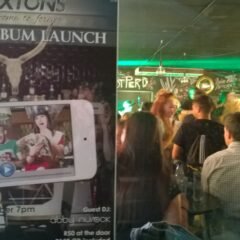
The 3, 2, 1 take-off: A weekend of launches.
by Ludwig Spies The Sextons launch their debut album Welcome to Forever The Sextons launched their debut album Welcome to Forever on Saturday, 7th November. The launch party took place at Dakota Lee Tattoo Shop & Rockabilly Bar in the Design on Appel complex in Kramerville, Sandton. Dakota Lee is a multi-faceted creative space infused with all the sexiness of rock and indie culture – the perfect venue for The Sextons’ unpretentious sound. Performing live, Jamie-Lee Sexton’s voice acquires a whole new level of intimacy that further enhances the narratives of the album. Instead of boring the crowd with long stories about the difficulty of success, The Sextons just got everyone excited with their lust for life and their authenticity. Welcome drinks were sponsored by Red Bull Summer Edition and live DJ’s played before and after the artist set. Welcome to Forever is currently available on iTunes. Caroline Leisegang hypnotises with her first album Øyeblikk Contemporary classical composer Caroline Leisegang introduced her album of pieces for piano to the public at a warm soirée hosted by Rabbit In The Moon at the Thrupps Illovo Centre, Illovo. Leisegang is partly of Norwegian origin and the music on this album is inspired in part by the elements of the melancholic and sometimes eerie Norwegian weather. A definite chill runs through her compositions that evoke images of frosted forests, icy creeks and quiet white expanses. Leisegang played Vinter (Winter) from the album, but prefers to cede concert playing to her friend and colleague Judith van der Wat aka Jude HarpStar. Leisegang explains that an able composer is not necessarily an equally able pianist. Van der Wat, a prodigious musical talent, played five pieces from the album: Drømme I (Dreams I), Forelsket (Falling in Love), Rød Regndråper (Red Raindrops), Drømme II (Dreams II) & Karusell (Carousel). Guests were treated to tapas-style cuisine and whilst the sounds of the piano spoke of snow and ice, we enjoyed a fine summer evening al fresco. Øyeblikk is currently available on iTunes. AGEO Menswear summer showcase and website ‘launch’ AGEO Menswear presented a showcase of their collections shown at the Mercedes Benz Fashion Week 2015 and the South African Fashion Week AW16 at Sandton’s The VIP Room . The event doubled as the brand’s website launch. Unfortunately, the party was not nearly as well attended as the pair from AGEO had hoped it would be, and logistical issues delayed the start of the showcase. A Google search on Monday revealed that the website is not yet live. In the meantime customers will have to stick it out with AGEO’s Facebook page...

Illustrator Bianca Brand presents Strange Creatures, a tribal mythology of unknown origin
By Ludwig Spies “I want people to be affected by my work.” Bianca Brand isn’t tall, she isn’t loud and she’s surprisingly nonchalant about her work. Yet affection is exactly what she achieves with her captivating imagery. She readily waives the title of artist in favour of being called an illustrator. On the difference between the two, Brand says that art expresses what the artist feels. “An illustrator has to predict what other people may feel and find a way to capture that. Illustrators specifically produce for an audience; we create posters, album covers, merchandising. It’s much less about us and much more about tapping into the audience’s emotions surrounding the product, organisation or event for which we are creating.” Although she creates for commercial purposes, Brand has a very strong and distinctive style. Instead of modifying her style to suit a brand’s corporate identity, she chooses to work with brands that are attracted to her style in the first place. “Developing your style is crucial”, she says. “It might seem like an obvious thing to say, but once you realise that your style is your single most important marketing tool, the thing that makes people notice and remember you, not a moment will go by without deeply and critically examining the finest details of what you create.” One might be surprised to learn that during her studies at Open Window, Brand struggled with colour use. She has since evolved into an illustrator particularly known for her use of bright, electric colours. “Most of my subject matter is quite dark and strange, and I feel that the colours prevent them from becoming scary or downright ugly. In this way, I hope that the works intrigue rather than disturb people.” Brand’s work is often incorrectly called surrealist. Her work hearkens back to much older art forms like rock painting and tribal art. Otherworldly figures and alien landscapes are all weaved together with the evident symbolism of lines and shapes and repetitions, creating the impression that one is viewing the pictorial mythology of an existing culture. The works seem to depict significant and sacred events and drive one towards finding a spiritual or ethical message. “I love narratives,” says Brand. “But these are not real stories, if that makes sense… I couldn’t tell you what’s happening in the pieces or what this one is about because they’re not about anything.” Instead of conceiving a tale and depicting it, she creates a piece with the potential for becoming a different story for different viewers. Many artists/creators claim to do something similar when they are, in fact, leaving lazy blanks and creating ill-conceived...

Maboneng’s POPArt Theatre presents We Didn’t Come To Hell For The Croissants
By Ludwig Spies If you’ve ever wished that you were crazy enough to bungee jump or take hard drugs, but felt that either might end in tragedy you’ll be happy to hear that someone has finally created an alternative. The POPArt Theatre & Performing Art Centre is currently staging a production of We Didn’t Come To Hell For The Croissants, a deeply thrilling and subversive piece that will make you laugh, gasp and tear up. Performed by Jemma Kahn and Roberto Pombo, and directed by Lindiwe Matshikiza, Croissants uses the traditional Japanese art of kamishibai to tell a series of seven stories loosely inspired by the seven deadly sins. The stories are illustrated on a set of large paper cards that slot into a wooden frame. As Kahn narrates the stories, and Pombo provides sound effects, she removes the cards one-by-one to reveal the next scene of the story. Kahn hates boring theatre. Thus, the stories are written and illustrated by different authors, and told as different genres in highly divergent styles. The first tale lulls like a bedtime story. This is followed, amongst others, by a scintillating musical number, a ‘dialogue’ in the form of a letter exchange, and a hilarious parody of a motivational speaker’s speech. The characters range from a deranged love-sick German youth, to a vengefully sadistic housewife to a glamorous Upper East Side housecat who inherits her owner’s fortune. Kahn so brilliantly brings the characters to life that one can barely decide whether to watch her or the edgy illustrations. Satirical commentary is woven into all the stories, and the postmodern irony is thick like lemon meringue. But instead of leaving the audience depressed and disillusioned, these tales of vulnerable, deeply flawed and authentic people reveal the most delicate of sentiments. There are scenes of terrific violence that possess a counter-intuitive beauty. There are scenes of explicit and ridiculous sexual encounters that amuse (and arouse…) without deteriorating into mockery. Some of the stories do contain a cautionary message, but they do not preach. Far from feeling old-fashioned, the low-tech, intimate production reminds of the Weimar cabaret of Berlin c. 1935. Kahn proudly describes the piece as queer theatre, and agrees that in many ways it is a revitalisation or a rediscovery of the vibrance that existed before that awful man with the small moustache came along. Croissants is labelled as a sequel to Kahn’s first kamishibai piece, The Epicene Butcher (And Other Stories For Consenting Adults) – another play with a ridiculously long and unintelligible, but highly satisfying name. Fortunately, your understanding of Croissants will not be hampered if you didn’t see the prequel....
We will be back!