Alison Kearney and Emily Stainer @ Goodman
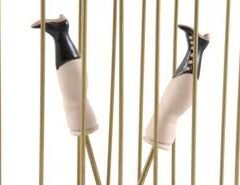
We forgot to let you know about this bewitching expo earlier this month – it’s running for another two weeks so get there! The Goodman Gallery is pleased to host a new body of work by two young South African artists from the 19th January to 9th of February 2008. This exhibition comprising new works in various media by Alison Kearney and Emily Stainer opens at noon on Saturday 19th January, on this day the gallery will have extended hours from 09h30 to 17h00. Alison Kearney is a South African artist interested in issues to do with the contexts of art production and display, as well as issues to do with how value is determined in culture. Within Kearney’s current art production, she explores the role of the audience in making meaning and contributing to the creative process when engaging with conceptual artworks, using a combination of mixed media, installation, and photography. In her most recent exhibition titled About Context, An exploration of Value in Four Parts [November 2006], Kearney asked audience members to participate in a performance work by bringing objects to exchange with her ad other participating audience members. The purpose of this public exchange was so that she would ultimately have a collection of objects to work with that she did not choose. The starting point for this exhibition is an engagement with, and documentation of the objects Kearney received. Kearney’s current interest is informed by her early works, which interrogate the institutions of art as institutions that to a large extent determine cultural value and influence cultural production, through parody of some museum practices. Included in this interrogation is an engagement with theories around public art through the construction of monuments which challenge the conventions around monuments through their subject matter, and also through the scale and the materials used. Emily Stainer is a South African artist and art historian, working in watercolour, mixed media and installation. Stainer was educated at the University of the Witwatersrand, Johannesburg and the Courtauld Institute of Art, London. The body of work that Stainer has created for this exhibition entitled Cautionary Tales, alludes to those popular nineteenth century children’s tales that sought to warn children about the perils inherent in life. In ‘Struwwelpeter’ (1845) by H. Hoffman there is a contradiction between the comic verses and the abhorrent punishments meted out to the characters. There is something paradoxical about the rhymes’ delight in cruelty and in their concern for the welfare of the child. The fairy tales by the Brothers Grimm include many stories of young people abandoned, kidnapped and sometimes even murdered. The perpetuation of this abuse is...
Represent Insists: William Kentridge
We know it’s been open about 11 days already, but we like picking up the momentum halfway through… SO Representer’s – we’re Insisting that you make the effort to get to this. People all over the world would LOVE to be able to pop into a Kentridge exhibition on their home way from work – think of it as a gift, one of our most iconic, respected and honoured artists, William Kentridge, gives you the free prize – a look at his recent work for mahala!!! Now don’t even consider looking this gift horse in the mouth – just point your car towards Jan Smuts Avenue and GO GO GO! William Kentridge I What Will Come 10 November – 14 December 2007 http://www.goodman-gallery.com/ Gallery hours: Tuesday – Friday 09h30 to 17h30; Saturday 09h30 to 16h00. An exhibition of recent work by William Kentridge opens on November 10th 2007, at the Goodman Gallery. This exhibition, entitled What Will Come takes its title from the Ghanaian proverb ‘What will come has already come’. Kentridge is renowned for his animated films, drawn and animated using trademark multiple erasure technique, in which he explores the nature of human emotion and memories, and deals with the quest for cultural identity, ingrained history and politics of South Africa, intensely dedicating himself to issues of sight in his work*. Through a series of new drawings, prints, and stereoscopic images that form the basis of What Will Come, Kentridge continues to explore the medium of sight, reflecting his continued concern with optics and the construction of seeing. The exhibition is centered around an eight minute anamorphic film, entitled What will come. This filmic anamorphosis in which images, drawn and animated by Kentridge, assume their proper form only when reflected in a mirrored cylinder positioned at the projection’s centre. This film draws on the idea of the picture puzzle that originated in the sixteenth century. Kentridge translates this play with perception that operates distorted images that can only be deciphered from a certain angle in his film. The technique of cylindrical mirror anamorphosis Kentridge employs is based on a further level of perception. It is not enough to change one’s point of view but a cylindrical mirror is essential to decode the picture, with a certain radius that reflects the distorted image, causing it to ‘straighten’ optically. The production of these images relies on Kentridge’s profound knowledge of mathematical rules and optical foundations*. A number of anamorphic drawings from the film will also be shown, mirrored in cylinders. Other work concerned with optics and the construction of seeing, includes series of stereoscopic photogravures that take on three dimensions as one looks...
CATCH THIS QUICK! Kathryn Smith
We have been wanting to catch this exhibition since it started but have been too busy – you only have two days to catch brilliant young artist and ex-Durbanite Kathryn Smith’s work “In Camera” at the Goodman on Jan Smuts – so Go Go Go. We’ll do our best! The Goodman Gallery presents Kathryn Smith’s In Camera, opening on September 15 at 18h00. This is her first solo exhibition since her Standard Bank Young Artist touring exhibition Euphemism (2004-2005). The exhibition closes 6 October, 2007. In Camera is a Latin phrase literally meaning ‘in private’ or ‘in secret’. It is most commonly used in legal cases where testimony is presented in private chambers instead of in open court. In camera testimony is most often facilitated where reliving the experience of a violent and traumatic event through verbal narration would be aggravated by having to do this in public. This opportunity is often given to victims of sexual assaults and children involved in criminal cases. Kathryn Smith’s In Camera presents a controlled, immersive environment featuring a series of portrait drawings, sourced from a range of print and online media photographs and processed so as to blur the distinction between the handmade and the mass-produced. Her subjects are the victims and perpetrators of violent acts, the circumstances of which remain almost incomprehensible in their extremity, even if the facts surrounding tabloid revelations of these cruel private desires are known. Smith is particularly interested in how, through repetition, certain photographic images get detached from their subjects and the representation of a person becomes emblematic of ‘victimhood’, ‘the missing’, ‘monstrosity’ or ‘evil’. This kind of rhetoric functions as a means to situate the perpetrators outside the realm of human behaviour and does not allow us to dwell on the particular circumstances of each violent interaction. Smith’s drawings have been made with ultraviolet-sensitive inks, invisible to the naked eye. As an artist known to work with performance and photo-based media, the choice of ink, brush and paper presents another way of processing the photographic image, particularly these images mediated and re-mediated such that they become like a retinal afterimage, a trace of something we have seen or experienced but which remains beyond our grasp. In setting up a relationship between the spectrum and the spectral, In Camera is an exhibition of ghosts, an attempt to reclaim that which eludes cognitive and emotional capture and retention. The installation comprises audio and lighting components, making use of both the Goodman Gallery’s public façade and display windows to accommodate aspects of the exhibition for evening...
Lolo Veleko @ the Goodman
Catch moving and shaking “street photographer” and artist Nontsikelelo “Lolo” Veleko at one of our favourite galleries, the Goodman in Jan Smuts avenue, closing on the 11 August. You can read more about Lolo in an interview on AfricanColours where they describe Lolo’s backstory as: Nontsikelelo Veleko started photography as a part time study course at the Market Photo Workshop in Johannesburg. Her first major photographic exhibition was “Seeing Women”, which took place at the Market Photo Workshop in 2005. This year she was selected to represent the Market Photo Workshop as participant at the Bieler Fototage, a Swiss photographic encounter. She was born in Bodibe, North West Province, South Africa and studied graphic design at Cape Technicon. In 1999 she enrolled at the Market Photo Workshop. Focusing on issues of the identity, Mute!Scream!Mute! examines how people present themselves to the outside world and thus construct their identities. Through the use fashion and clothing Nontsikelelo Veleko questions perceived notions of beauty. She focuses her lens on those around her, but at times she also turns the lens towards herself, posing both in guises of various identities and representing herself in self-portraiture. Focusing on issues of the identity, Mute!Scream!Mute! examines how people present themselves to the outside world and thus construct their identities. Through the use fashion and clothing Nontsikelelo Veleko questions perceived notions of beauty. She focuses her lens on those around her, but at times she also turns the lens towards herself, posing both in guises of various identities and representing herself in self-portraiture.The exhibition comprises three series of photographs. http://www.notblackenough.lolo/, a project that emerged out of Nontsikelelo Veleko’s early interests in issues surrounding identity in 2002. In this series of photographs she uses the self to explore South Africa’s mixed cultural heritage, assuming other peoples identities by donning different clothes and props. Her images challenge perceptions about identity that are based on appearances and historical assumptions (Murinik 2007). http://www.notblackenough.lolo/ explores Veleko’s identity in terms of the way other black people view her. Placed in the context of urban life, Beauty is in the eye of the Beholder, continues Veleko’s exploration of identity. Beauty is in the eye of the Beholder is a study, documentation and constructing of urban street fashion culture in Johannesburg, South Africa. It specifically looks at urban fashion around Johannesburg’s city centers and surrounding townships. Veleko uses this series of photographs to examine how people present themselves to the outside world and construct their identities. These portraits challenge perceptions of beauty, examining the very act of judging others in terms of the external identities that they project. A new photographic series of Self Portraits will also be exhibited...
We will be back!